
Overview
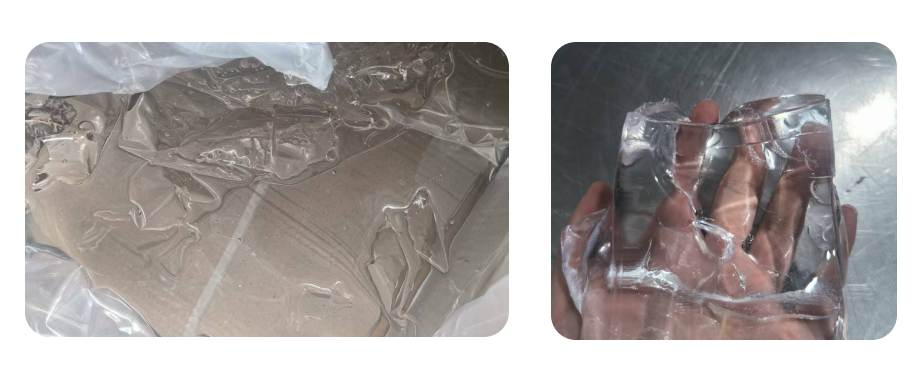
Fluorosilicone gum is a polymer with a siloxane backbone and trifluoroalkyl groups on the side chains. Its polymerization method is similar to that of dimethylsiloxane rubber, produced by ring-opening polymerization of cyclic siloxanes.
Although the heat resistance and chemical resistance of fluorosilicone rubber are not as strong as those of other fluoroelastomers, it combines the advantages of both silicones and fluororubbers: the siloxane backbone provides flexibility and thermal stability, while the fluorine substituents enhance fuel and solvent resistance.
It can be used across a wide temperature range of -60 °C to +200 °C, showing excellent resistance to fuels and oils, with minimal swelling in methanol.
Applications
Aerospace industry: fuel- and lubricant-resistant seals and contact components in aircraft.
Automotive industry: seals, oil seals, diaphragms, hoses, valve linings.
Petrochemical industry: high- and low-temperature chemical-resistant seals for pumps, valves, tanks, and related equipment.
Medical and healthcare field: components in medical devices and artificial organs.
Military industry: seals and parts for harsh environments requiring low-temperature, oil-, and acid-resistance.
Product Advantages
Fluorosilicone rubber combines the strengths of silicone and fluoroelastomers:
Wide operating temperature range (-60 °C to +200 °C).
Excellent resistance to fuels, oils, solvents, and chemical media.
Retains silicone rubber’s high tensile strength retention at elevated temperatures.
High consistency, low volatility, odorless, with excellent thermal stability.
Product Grades
(Different grades available – see catalog for details.)
Gum Quality
The performance of fluorosilicone compounds depends directly on the structure of the gum. For methyltrifluoropropyl vinyl polysiloxane gum, the vinyl content and its distribution greatly influence the physical properties and curing behavior of the vulcanized elastomer.
Vinyl content
– Higher vinyl content increases crosslink density, improving hardness and tensile strength while reducing elongation and compression set.
Vinyl position and distribution
– Vinyl-terminated gums deliver better vulcanizate performance compared to non-vinyl-terminated general grades.
– This is because terminal vinyl groups contribute to chain extension during crosslinking, thereby improving the mechanical properties of the cured elastomer.
– Our company uses high-purity D3F as the raw material to achieve more uniform vinyl distribution on the side chains, which enhances crosslink density and improves rebound performance.
